
Single-Deck vs. Multi-Deck Blackjack: Which One Gives You the Best Odds?
Blackjack’s simple rules and need for strategic thinking makes it one, if not the, top casino game of choice for players worldwide. Blackjack offers some of the best odds in the house. But it’s also one that can pay out handsomely if you play your cards right. But not all blackjack games are created equal. One of the biggest variables that can impact your chances of winning is the number of decks used in play. So, today we’re delving into one of the game’s biggest debates: is single-deck blackjack better, or is multi-deck blackjack?
This article breaks down the differences between the two. We explore how the number of decks affects the house edge, and how playing with either number of decks can help you determine which fits you and your playing style.
Let’s Get Down to Basics: What’s the Difference?
At first glance, the game mechanics are nearly identical whether you’re playing with one deck or eight. You’re still aiming to beat the dealer by getting closer to 21 without going over. And most rules around hitting, standing, and doubling down remain the same.
The key difference lies in how the probabilities shift depending on the number of decks. In a single-deck game, there are only 52 cards in play. With multiple decks, you could be looking at 312 cards (in a six-deck game) or even more. This difference may seem subtle, but it significantly impacts the math behind the game.
House Edge: How the Decks Stack Up
The house edge is the built-in advantage that casinos hold over the player. In blackjack, the house edge is affected by several factors: rules for doubling down, dealer behavior on soft 17, and whether blackjack pays 3:2 or 6:5, but the number of decks is one of the biggest contributors.
Here’s how the house edge typically changes based on the number of decks, assuming all other rules are equal and blackjack pays 3:2:
- Single-deck: ~0.17% house edge
- Double-deck: ~0.46%
- Four-deck: ~0.60%
- Six-deck: ~0.64%
- Eight-deck: ~0.66%
As you can see, the fewer the decks, the lower the house edge. In theory, a well-played single-deck game offers the best chance for players to come out ahead. But in practice, it’s not always that straightforward.
Why Single-Deck Isn’t Always Better
On paper, single-deck blackjack looks like the clear winner. However, many casinos have caught on to this and adjusted the rules to compensate.
Here are some common trade-offs in single-deck games:
- Blackjack pays 6:5 instead of 3:2 – This change increases the house edge by around 1.4%, completely negating the advantage of a single deck.
- Limited doubling down options – Some single-deck games only allow doubling on certain hands (e.g., totals of 9, 10, or 11).
- No resplitting aces – You may only be able to split once and won’t be able to double after a split.
These rule tweaks mean that some single-deck games actually have a higher house edge than well-ruled multi-deck tables, especially if the latter pays 3:2 and allows doubling after splits, late surrender, and other player-friendly options.
Card Counting Considerations
Card counting is a technique used by skilled players to gain an edge by tracking the ratio of high to low cards left in the deck. The fewer the decks, the more powerful and accurate card counting becomes.
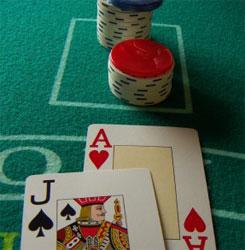
That’s because in a single-deck game, each card has more weight in the remaining pool. If you see four tens in a single-deck game, you know there are only 12 left. In an eight-deck game, seeing four tens is barely a dent in the 128 that were originally in play.
Casinos know this, too. They watch single-deck games for potential counters. Many have continuous shuffling machines or frequent reshuffles to make counting difficult. If you’re playing real money blackjack online at Slots of Vegas, card counting simply won’t work. This is due to the fact that online games rely on random number generators (RNG) to shuffle the deck thoroughly each time. This is regardless of whether there’s one deck in play or multiple.
Strategy Adjustments: Single vs. Multi-deck Blackjack
Basic blackjack strategy, aka the mathematically correct way to play each hand, shifts slightly depending on the number of decks. In a single-deck game, for example, you’re more likely to hit on certain hands than you would in a multi-deck setup. The differences are minor, but important for players who want to maximize their edge.
One example: with a hard 16 vs. a dealer’s 10, some single-deck strategies recommend standing rather than hitting, especially if surrender isn’t an option. In multi-deck games, you’d usually hit.
If you’re serious about improving your game, it’s worth studying a deck-specific basic blackjack strategy chart. These are widely available online and easy to learn with some practice.
Which Game Should You Choose?
The right blackjack game for you really depends on your experience level and what you’re hoping to get out of the session.
If you’re a beginner, a multi-deck game with straightforward rules and a fair 3:2 payout on blackjack is a great place to start. It keeps things simple and gives you decent odds without too much complexity.
For intermediate players who understand basic strategy and want a slightly better edge, a double-deck or even a single-deck game with favourable rules (like dealer standing on soft 17 and doubling after splits allowed) can be a smart choice.
If you’re an advanced player and know how to count cards, a single-deck game with minimal shuffling is ideal. Though these are increasingly rare and closely monitored by casinos.
And if you’re a recreational player who’s just in it for the fun, choose the version that feels most enjoyable and fits your budget. The entertainment factor is just as important as the odds.
If you’re not counting cards and just looking to enjoy a few hands, don’t get too hung up on the deck count. Just focus on finding a table with friendly rules and 3:2 payouts.
Odds Are Just the Beginning
The number of decks in play does influence your chances, but it’s only part of the bigger picture. A smart player looks at the full rule set. This includes things like how blackjacks pay out, when you can double down, and whether the dealer hits on soft 17.
In theory, single-deck blackjack gives you the best odds. But in reality, casinos often tweak the rules to take that advantage away. Always check for fair payouts like 3:2 on blackjack, flexible doubling options, and player-friendly rules. Whether you’re playing for fun or with strategy in mind, knowing how deck size shapes the game gives you a definite edge.
